Contacts, pledges, payments, sponsorships, events, statements and your public website — one system, one ledger. Every payment lands on the right account the moment it is made, including the ones made on your website by someone who never logged in. And it is branded so completely that your members will take it for software built for your shul alone.
Live demo congregation you can browse right now — no signup, no sales call first.
A membership spreadsheet. A payment processor. A website somebody built years ago. Every month somebody reconciles them by hand — and every month a payment goes missing.
Someone donates $180 on the shul website. It hits the processor. It never reaches their account. The office finds out when that member is billed for money they already paid.
An aliyah is pledged on Shabbat, written on a card, typed in on Tuesday — if it gets typed in at all. Nobody can answer "what do I owe?" without three phone calls.
Prayer times changed, but the site says otherwise, because updating it means emailing the volunteer who has the password. So it stays wrong.
This is the failure we hear about most, and it is the thing this platform was built around. Your website and your portal are not two systems talking over an integration — they are one system with two front doors. A payment made on the public site is written straight into the same ledger the office works in.
Donation, kiddush sponsorship or an event ticket — no login needed.
Same database as the office. Not an export, not a nightly sync.
Known payer: instantly. Stranger: one click, and their whole history follows.
Anyone paying from a statement link or logged into their account is identified before a card is ever charged. The payment is written against their record with the pledge it settles, and their balance moves the same second.
A stranger's payment is recorded with the name, email and phone they typed, and flagged in the office as unattached. One click turns it into a contact — and retroactively adopts every other unattached payment that used the same email.
Not a CRM you have to bend into a synagogue shape. Built around aliyot, kiddush sponsorships, High Holiday seats and yahrzeits from the first line of code.
Households, spouses, children, yahrzeits and aliases. Membership tiers separate from plain contacts, so a donor is not accidentally a member.
Every aliyah, every kiddush, every membership fee. Pledges and their charges stay in lockstep, and payments allocate oldest-first without anyone doing arithmetic.
Open a date at a price you set; a member books it from their phone or the public site. Slots are held atomically, so two people cannot take the same Shabbat.
Ticketed events with member and non-member pricing, adults and children counted separately, optional capacity caps, and High Holiday seats priced by tier.
A branded statement any member can pull themselves, a running balance they can follow, and an emailed receipt for every payment — with an opt-out.
Prayer times, classes, events and holidays edited in the portal and live on your site — with donations and sponsorships that land on the right account.
Beth Knesset is our demo congregation — a complete, working shul on the platform, with a public website wired to a real portal. Browse it before you talk to anybody.
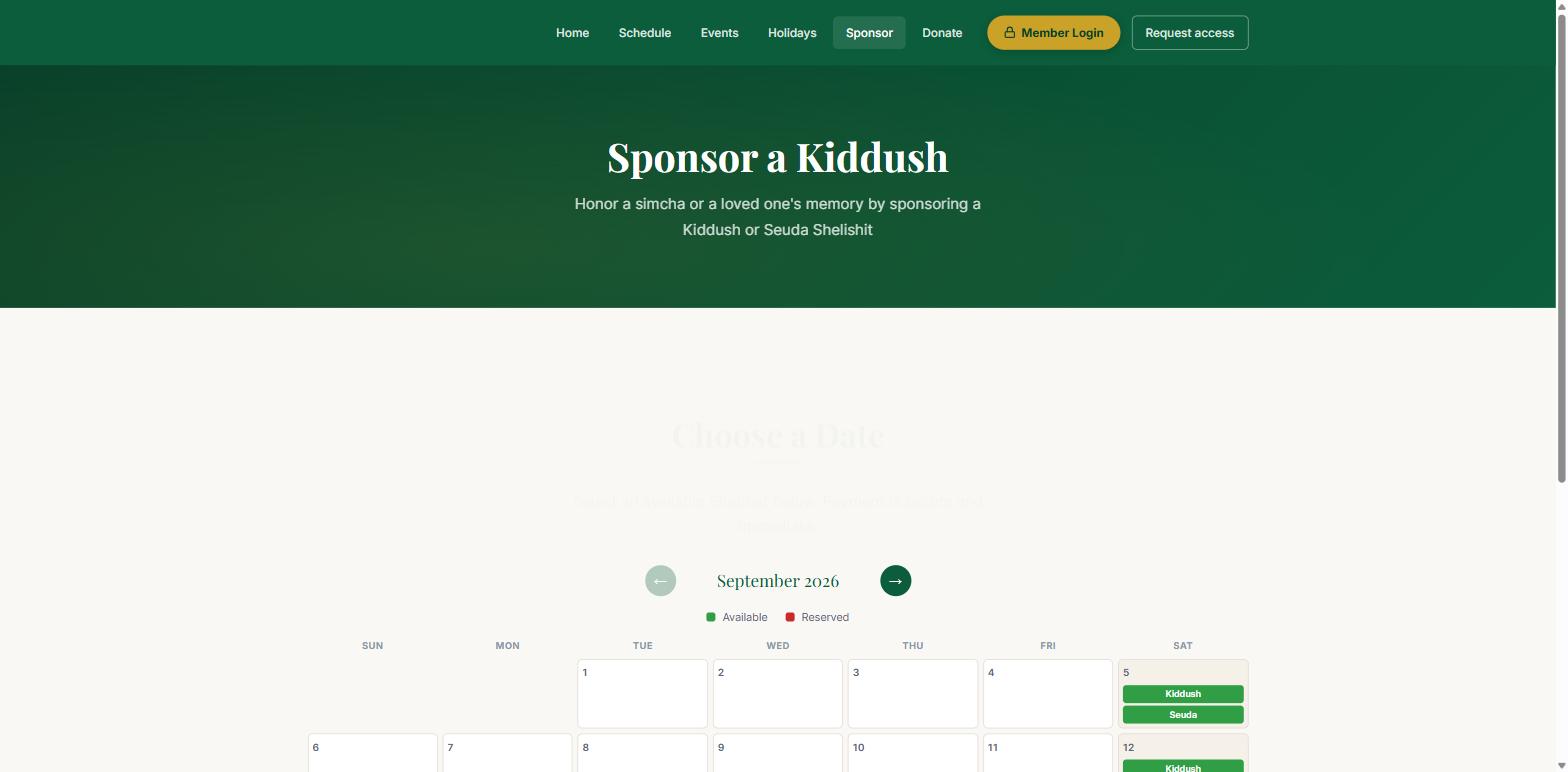
A real sponsorship calendar on the demo site — the open dates are worked out on the server as the page loads, from the same records the office edits.
Not a product with your logo dropped in a corner. Your members open the portal and the website and see your congregation's own system — because as far as they are concerned, that is exactly what it is. Two shuls running on this platform can share not one pixel.
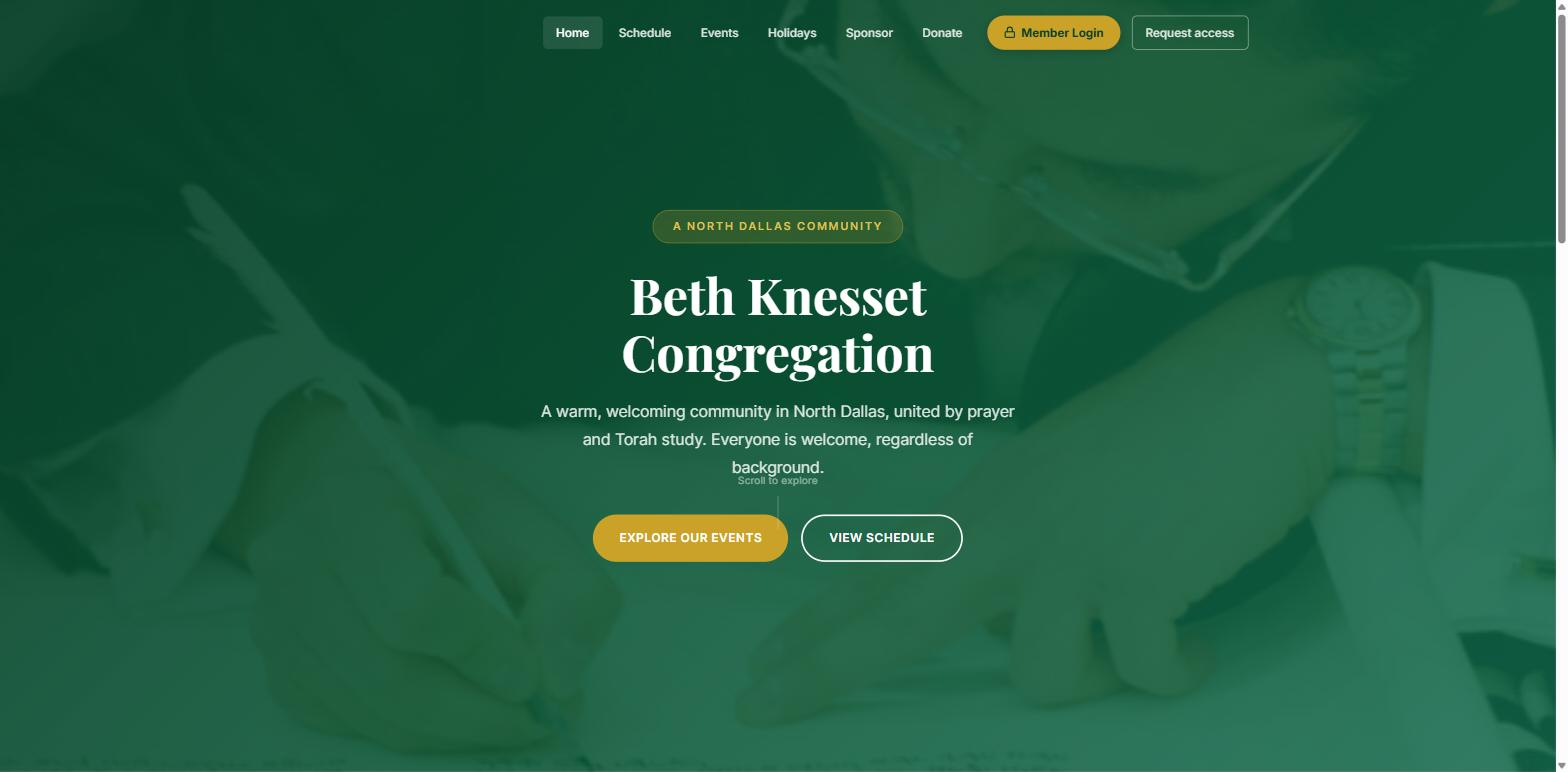
Beth Knesset chose emerald, gold and a classical serif. Nothing on the page — or in their portal, or on their statements — announces the platform underneath. That is the point.
Two things a shul office is asked for constantly, and the two most people are surprised to find in the same place.
Charges on one side, payments on the other, netting to a balance you can defend to a treasurer or an auditor. Every figure traces back to the row that produced it, and every row is stamped with who touched it.
See the ledger →Create it, drop in a flyer, attach the tickets and their prices, save. It is on your website with a working checkout immediately — no developer, no deploy, and every purchase lands on the buyer's account.
See the steps →Members download their own full history — every pledge, payment and donation, with a running balance — as a spreadsheet or a branded statement, any time, without asking the office for anything.
See what they get →A shul database is a list of who belongs to your community, what they give and how to reach them. It deserves better than a shared spreadsheet on somebody's laptop.
Tokenisation happens in the payer's browser. The card number never reaches our servers, so it cannot leak from them.
Every request is verified at the gateway and again inside the application. A mistake in one is caught by the other.
Records are cancelled, not destroyed. A year later you can still answer what happened, when, and who did it.
Send us a membership list and a year of transactions. We will load them into a private demo and walk you through your own shul, not a fictional one.